Data & AI
How AI Ends the One-Size-Fits-All Loyalty Rewards
Published on: August 18, 2026
5 Mins Read
Faiszal Anwar
Growth Manager at Antikode
Share on

For years, marketing has promised personalization. In practice, it often meant something much smaller: a customer’s name at the top of an email, followed by the same message and offer everyone else received.
It looked personal. It rarely responded to the individual.
That is beginning to change. Artificial intelligence is making it possible for brands to move beyond broad customer groups and shape loyalty rewards around individual behavior and timing.
Instead of sending everyone the same coupon, brands can begin to match different customers with different rewards, based on what they do and when a reward is most likely to matter.
The shift is not simply about making marketing look more personal. It changes how brands decide who receives a reward, what kind of reward they receive, and when they receive it.
What Personalization Used to Mean
The limitation was never ambition. It was capability.
Brands could not realistically design a different reward for every customer, so they grouped people into broad segments: large customer groups based on shared characteristics or behavior. Each group then received a similar offer.
The result felt more tailored on the surface, but the underlying logic had not changed. A customer might see their name at the top of an email, yet still receive the same fifteen percent discount as everyone else, whether they needed it or not.
That was personalization at the surface level. The name changed, but the decision behind the offer often did not.
From Segments to Individuals
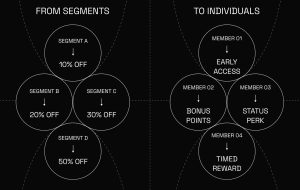
AI changes the scale at which brands can respond to customer behavior.
Instead of creating one offer for a broad customer group, brands can identify patterns in what an individual buys, which rewards they use, how often they return, and when they stop engaging. Those patterns can help a brand choose a reward that is more likely to matter to that person.
Consider two customers at the same coffee brand. One visits every day. The other used to visit weekly but has not returned for a month.
Regular customers may not need a discount. Early access to a new drink or a status benefit may feel more valuable because it recognizes an existing relationship.
The customer who has stopped visiting may need something different: a timely reward that gives them a reason to return.
The brand is the same. The reward budget may be the same. But the decision is different because the customer behavior is different.
Timing matters just as much as the reward itself. A small reward delivered at the right moment can be more effective than a larger one sent broadly at the wrong time.
The Cost of Giving Everyone the Same Reward
Giving everyone the same reward creates costs that are easy to overlook.
The first is margin. A blanket discount rewards customers who may have purchased it anyway. The brand spends money without changing the decision.
The second cost is behavioral. When customers repeatedly receive the same discount, they learn to wait for it. Over time, a brand can train even its most loyal customers to behave like discount hunters.
Personalized rewards address both problems.
They direct incentives toward moments where a reward is more likely to influence a decision. At the same time, they reduce spending on customers whose behavior did not need to be rewarded.
The goal is not to send more rewards. It is to use them where they can actually change a decision.
Loyalty Data Makes Personalization Possible
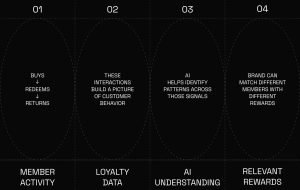
There is a catch, and it is the part many brands underestimate: AI does not create customer understanding from nothing.
It needs a clear record of how customers actually behave. A loyalty program is one of the strongest sources of that information.
Every time a member earns points, redeems a reward, makes another purchase, or stops returning, they reveal something about their habits. Over time, those interactions create a behavioral picture that the brand owns rather than rents from an outside platform.
This is often called first-party data: information a brand collects directly through its own interactions with customers. The value of a loyalty program therefore goes beyond the points themselves. It also lies in the customer data created through repeated interactions.
AI is what allows brands to use those signals at the level of the individual.
When Everyone Has AI, Data Becomes the Difference
As access to AI becomes more common, technology itself becomes less distinctive.
Two brands may use similar models and still achieve very different results. The difference lies in the depth, quality, and continuity of the customer data behind those models.
One brand may only know that a customer belongs to a broad group. Another may understand what that person buys, how often they return, which rewards they use, and when their behavior begins to change.
The second brand has a stronger foundation for relevant personalization.
The model may become a commodity. The data is not.
The more useful question is therefore not only which AI a brand should use. It is whether the brand has built customer data that makes technology valuable.
Personalize Without Losing Trust
Greater personalization also creates greater responsibility. Personalization earns trust when it feels like recognition. It loses trust when it feels like surveillance.
A useful test is simple: could the brand clearly explain why a customer received a particular reward, and would that customer be comfortable with the explanation?
If the answer is yes, personalization is likely helpful. If the explanation feels intrusive, that is a signal to stop.
The healthiest approach is to treat personalization as a fair exchange. Customers share information through the loyalty program, and in return they receive genuine value.
From there, it is better to personalize one important moment well than to personalize everything at once.
Winning back a customer who used to return regularly but has since gone quiet is often a useful place to begin. The difference between a generic message and a well-timed reward can be easier to observe in that moment.
Start with one meaningful customer moment. Measure whether the reward changes behavior, learn from the result, and then expand.
Meaningful personalization does not require a sweeping AI program. It requires reliable data and one customer moment worth getting right.
The One-Size-Fits-All Reward Is Ending
For years, personalization often meant adding a name to a message designed for everyone.
AI is finally making something more meaningful possible: rewards shaped around the behavior and timing of the individual.
The one-size-fits-all reward is ending. What replaces it is not simply smarter automation, but a more relevant way of treating customers as individuals.
Faiszal Anwar
Growth Manager at AntikodeFaiszal is a growth marketer passionate about data analytics and digital strategy. He excels in aligning data strategies with broader experience design and platform deployment.